
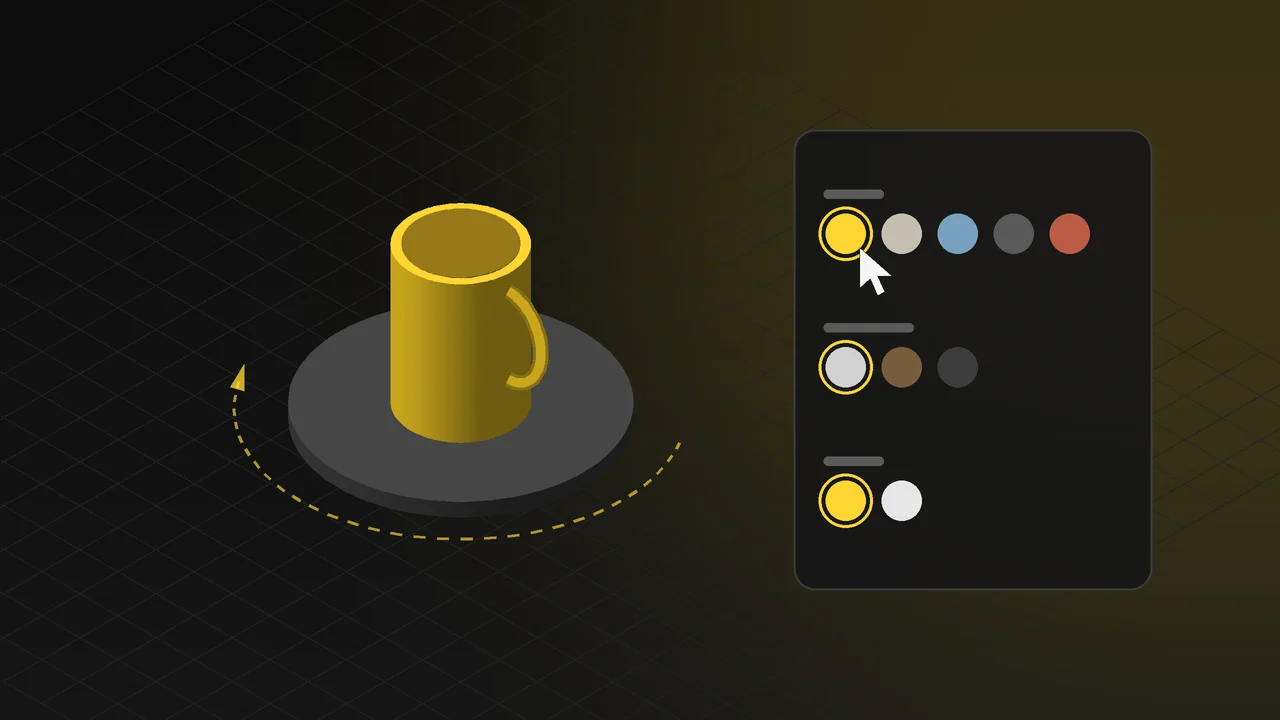
If a product comes in five colours, three materials and two different prints, shooting a separate photo of every combination is both expensive and slow. And the customer often still cannot see the exact combination they are curious about. A 3D product configurator solves this: the product sits on your website in 3D, and the moment a visitor changes an option, they see the result with their own eyes.
In this article we explain what a 3D product configurator is, how it works, which products it suits and how to prepare for a configurator project, with examples you can try in your browser right now.
Try a live 3D product configurator
What is a 3D product configurator?
A 3D product configurator is an interactive application that shows a product's 3D model on a web page and lets the visitor customise it in real time. The visitor rotates and zooms the product with the mouse or a finger, changes colour, material, fabric, print or part options, and sees every change instantly.
The configurator runs directly in the browser (Web3D/WebGL). The visitor does not need to download an app or install a plug-in; it opens with the same link on desktop and on mobile.
Live example: ten industries, one page
Our 3D Web App puts the examples we built for ten industries on one page: a chair with changing fabric, wood and legs, cosmetics bottles whose caps open, a sports car whose doors open, headlights switch on and interior changes, a smartwatch whose display shows the real time, a coffee grinder with a changing grind setting and a removable portafilter, a paper cup with changing print and sleeve, a turbine that spins with the wind, an air handling unit whose panels come off to show the inside and a compressor that comes apart. Pick your brand colour and the interface and the product change together.
You can start straight from your industry: furniture, cosmetics, automotive, tires and wheels, watches and accessories, packaging, energy, industry. For other ways to visualise furniture, see our article on furniture product visualization.
From our earlier configurator projects
In the cup configurator we built for glass and ceramic products, material, body colour and print changed in real time. In the furniture configurator, the chair's fabric, colour and material could be tried in the browser. Videos of both projects:
How does a configurator help sales?
- Customers see exactly what they want: Even a colour and material combination with no photo in your catalogue appears on screen. "How does this fabric look in this colour?" is answered without going to a sales rep.
- Fewer photo shoots: There is no need for a shoot for every new colour, print or variant. Adding a new option is as easy as defining a new material in the configurator.
- Clearer orders: Because customers approve the combination they have seen, misunderstandings and returns go down. Their selections can be sent to you as a summary or a quote request.
- Longer engagement with the product: A visitor who rotates, zooms and tries options spends far more time on the page than one who looks at a few photos, and gets to know the product better.
- A tool for dealers and sales teams: The same configurator can be used on a tablet at trade shows, in the showroom or on customer visits.
Which products is it suitable for?
| Sector | What can change in the configurator |
|---|---|
| Furniture | Fabric, leather, colour, leg and arm style, layout of modular pieces |
| Glass, ceramics, packaging | Body colour, material, print and logo placement |
| Machinery and equipment | Optional parts, colour, accessories; together with technical values |
| Doors, windows, building products | Profile, colour, finish, glass and accessory options |
| Promotional products | Customers seeing their own logo on the product |
In short, any product with many variants, or one sold customised for each customer, is a good candidate for a configurator.
What else can Web3D do besides configurators?
The same technology can power not only configurators that change options but also pages that tell the product's story. In the cosmetics example the visitor picks a bottle, opens its cap and reads the label up close; in the industry example the compressor runs and switches to an exploded view. You can see every sector in our 3D Web App.
3D configurator vs 360° photos vs AR
These three are often mentioned together, but they solve different problems. Many brands use them side by side.
| 3D product configurator | 360° product photos | AR (augmented reality) | |
|---|---|---|---|
| What the visitor does | Rotates, zooms and changes colour, material and parts in real time | Spins a sequence of photos of one finished product | Places the product in their own room or on their own desk through the phone camera |
| Variants | Every combination from one model | One shoot per variant | Usually a few ready variants |
| Products not yet made | Yes, from CAD or drawings | No, needs the physical product | Yes, from the same 3D model |
| Best for | Products with many options or made to order | Simple products with one or two variants | Furniture, decor and products where size in the space matters |
A configurator and AR can share the same 3D model: the visitor builds their combination on the product page, then views it in their room with one tap. For how the model is prepared, see 3D product modeling.
Adding a 3D configurator to Shopify, WooCommerce or your own site
A configurator does not require a new website. It runs as a web component and is added to the product page you already have:
- Shopify: The configurator is embedded in the product template; the visitor's choices can be passed to the cart as product options. See how to add 3D products to Shopify.
- WooCommerce: The same approach works on WordPress product pages, with the selection sent to the order or to a quote form. See the WooCommerce 3D product viewer guide.
- Custom sites and B2B portals: The configurator is published on its own page or inside your site, and the result can be sent as a summary, a PDF or a quote request to your sales team.
Because the 3D model is optimised for the web and loads only when it is needed, the rest of the product page stays fast.
How is a configurator built?
- Defining the options: What the visitor can change (colour, material, parts, print), which combinations are valid and what happens at the end of the selection (quote request, order, sharing) are agreed.
- 3D modelling: The model is prepared from the product's CAD file, technical drawing, or photos and dimensions. It is simplified so it loads fast on the web; for details see our article on 3D product modeling.
- Materials: Every fabric, paint and surface is prepared to look realistic and defined as an option in the configurator.
- Interface and camera: The option panels, the camera angles the product opens with and the transitions are designed.
- Testing and launch: Speed and image quality are tested in desktop and mobile browsers, and the configurator goes live on your own domain or inside your existing site.
Frequently Asked Questions
Does the visitor need to download an app?
No. The configurator runs directly in the web browser and opens with the same link on phones, tablets and computers.
Can it be added to our existing website?
Yes. The configurator can be published as a separate page or embedded in the product pages of your existing site.
Can the configurator's 3D model be used for other work?
Yes. The same model can also produce photorealistic product images for catalogues and e-commerce, and product animations. The model is prepared once and used across different content.
Will a 3D configurator slow down my product page?
No, when it is built for the web. The model and textures are compressed, phones receive a lighter version automatically, and the 3D content loads after the rest of the page, so text and images appear first.
Can new colours or materials be added later?
Yes. Adding a new option does not require remodelling the product; a new material is prepared and defined in the configurator.
What determines the price?
It depends on the product's complexity, the number of options, the image quality required and how the configurator connects to your site. If you describe your project with our brief template, we can prepare a clear quote for you.
Tell us briefly which options you want to offer your product with, and we will work out the right configurator plan together. Take a look at our 3D web design and product configurator service or get in touch.